 (+48) 508 425 378
 office@bitpeak.pl
 Opatowska 2, Warsaw

The client
SITA is a global leader in air transport communications and IT solutions. Drives digital transformation for more than 400 customers, covering 18,000 commercial aircraft and partnering with over 90 air navigation service providers. Serving 90% of the world’s airlines, SITA offers solutions like digital operations management, aircraft data handling, and seamless communication services for aircraft.
The situation
The aviation sector relies on reliable, timely data to manage operations, ensure safety and deliver services to passengers. As data volumes grow across connected aircraft and digital systems, analytics platforms must deliver stable, uninterrupted performance at scale. For providers serving airlines directly, such as SITA, accuracy and availability are business-critical.
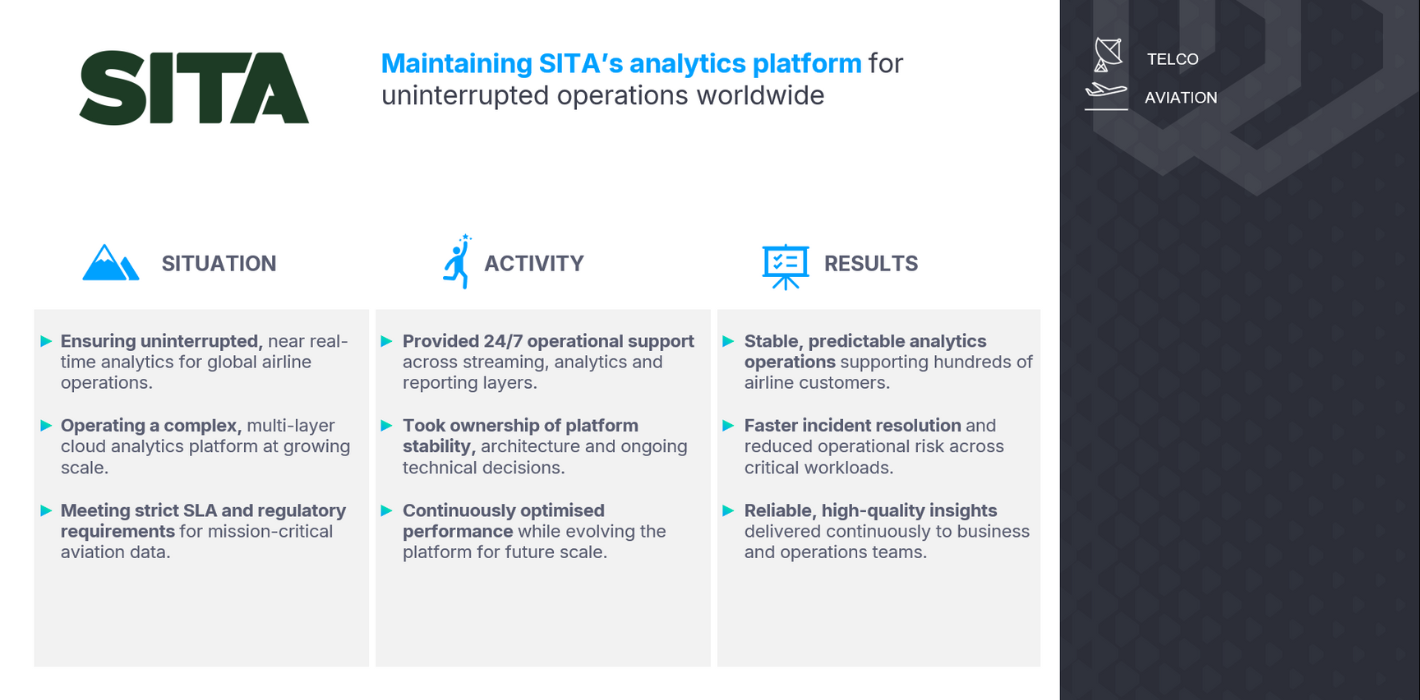
Building on previous data and AI initiatives, ranging from advanced analytics to solutions supporting safety and operational decision making, our partnership with SITA evolved into responsibility for the long-term stability and development of its cloud analytics platform, which supports hundreds of customers and mission-critical operational workloads.
Key requirements included:
- Ensuring uninterrupted, near real-time data access for global airline operations – building trust through speed and reliability
- Driving platform evolution to meet growing demand and changing business needs
- Meeting strict SLA targets with rapid, cross-domain incident response – enhanced by AI-driven early anomaly detection
Our activity
SITA’s analytics environment operates at a scale where data must move reliably 24/7. Our role focuses on keeping this ecosystem fully operational while steadily improving its performance and preparing it for future demands across multiple aviation business areas.
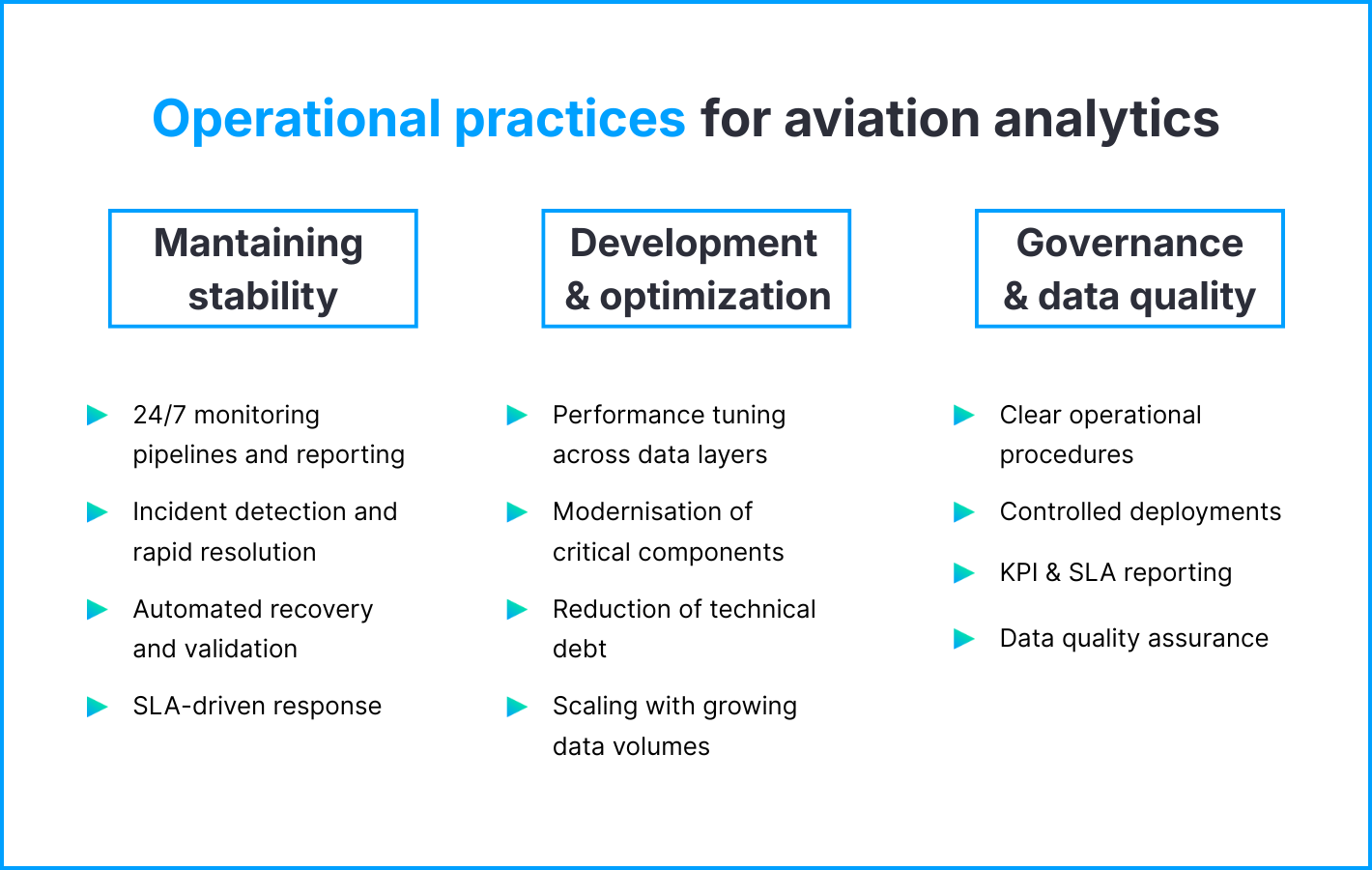
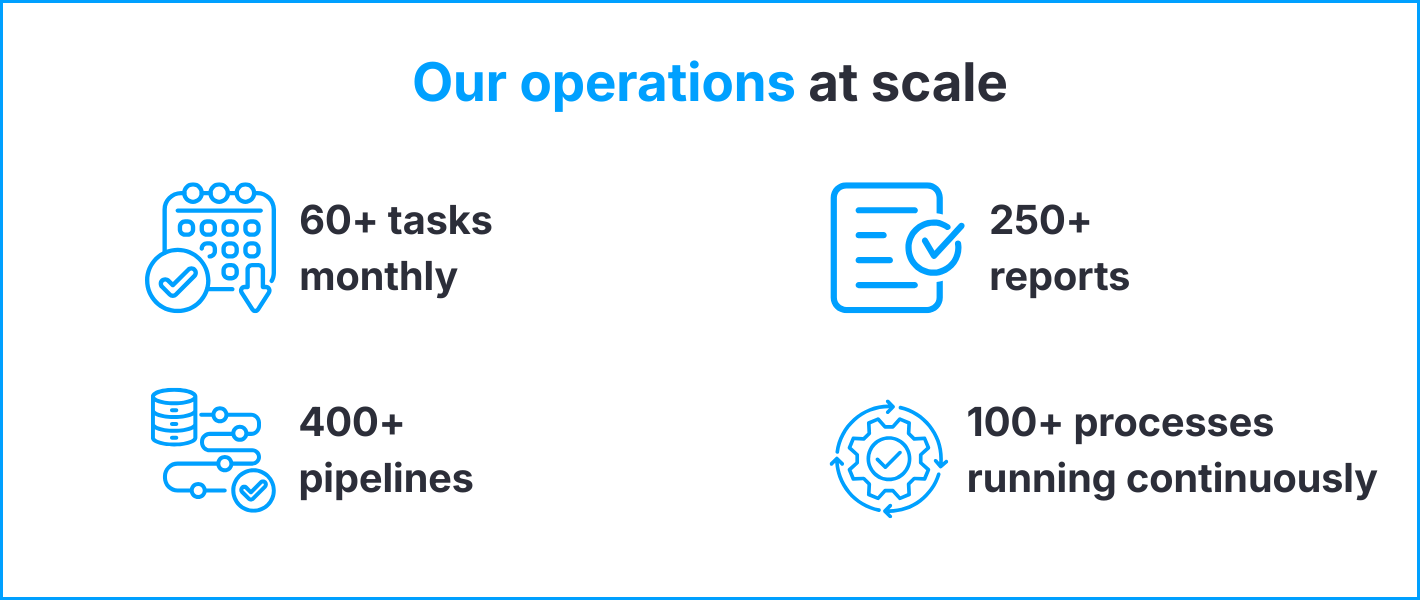
This is not a traditional support model limited to incident response. Our role spans second- and third-line support and includes ownership of the platform’s architecture and codebase. Beyond resolving issues, we make technical decisions that support long-term stability and scalability. The scale of our work is reflected in the operational numbers.
In the project we use the following tech stack:
Cloud & data platform
- Microsoft Azure
- Azure Data Lake
- Azure Data Factory
- Azure Synapse Analytics
- SQL Managed Instance
Advanced analytics & processing
- Azure Databricks
- Delta Lake
Streaming & integration
- Azure Event Hubs
- Azure Functions
- Azure Logic Apps
Business intelligence
- Power BI
- SQL Server Analysis Services (SSAS)
DevOps & automation
- Infrastructure as Code (Terraform, ARM templates)
- CI/CD pipelines
Benefits:
Management
The platform operates predictably and with full transparency, supported by clear KPIs, SLA reporting and consistent governance. With reduced incident frequency and faster recovery paths, leadership gains confidence in the stability of a system relied upon by hundreds of aviation customers. Regular improvements and controlled upgrades keep long-term operational risk low and maintain strategic readiness for future growth.
Business teams
Daily reporting, streaming analytics and customer-facing insights remain reliable, even as data volumes grow or new requirements emerge. Teams can make decisions based on accurate, up-to-date information without interruption, benefiting from stable data quality and timely delivery. Clear communication around deployments and planned changes allows business stakeholders to plan confidently and avoid disruptions.
Operations
A modernised and optimised environment reduces manual work, removes bottlenecks and shortens delivery cycles for new features. Automated QA, streamlined deployments and continuous architectural improvements increase development velocity while lowering maintenance overhead. With technical debt systematically reduced, teams can focus on evolving the platform rather than firefighting operational issues.