 +48 453 250 842
 office@bitpeak.com
 Opatowska 2, Warsaw


The client
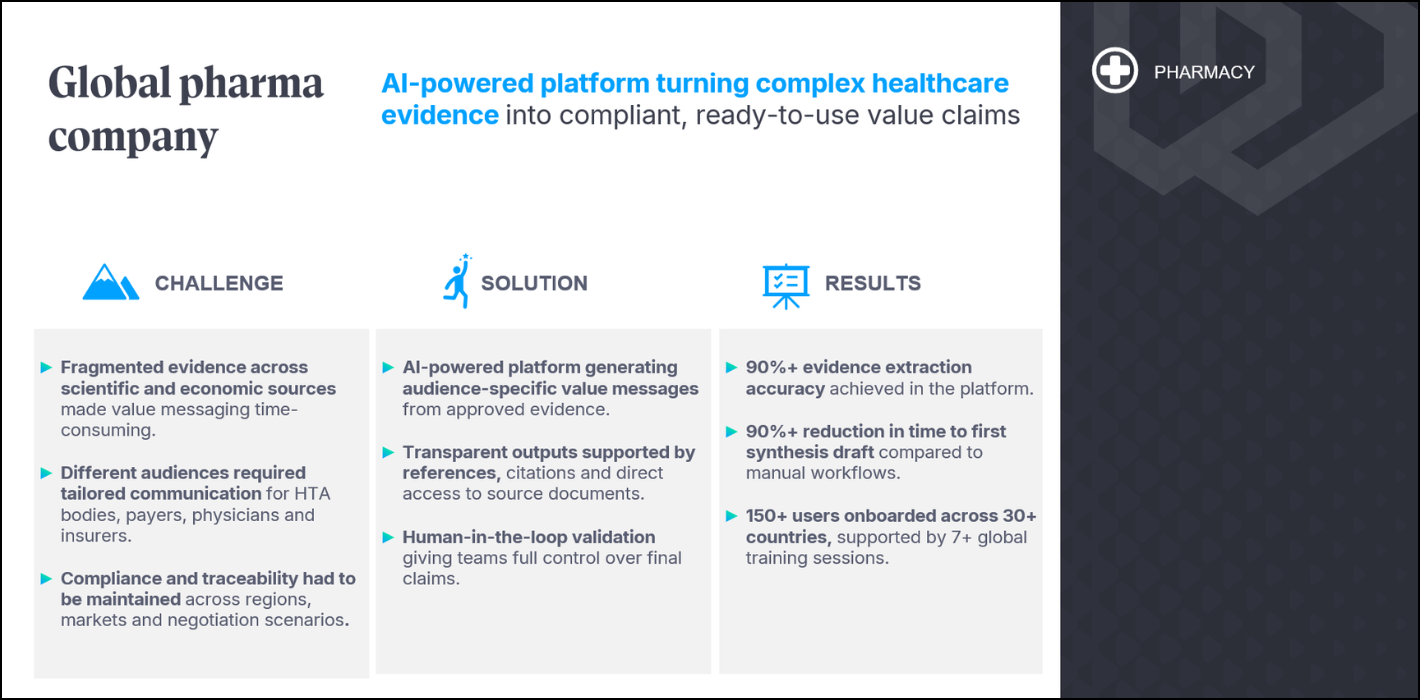
A globally diversified healthcare company with a central purpose to help people live their healthiest possible lives. The organization offers a broad portfolio of market-leading products that align with favorable long-term healthcare trends in both developed and developing markets. With more than 115 000 employees and 4000+ FLMs in 160+ countries discovering new ways to make life better.
The challenge
In healthcare, market access and commercial teams need to translate complex scientific and economic evidence into clear value messages for very different audiences. Public payers, HTA bodies, physicians, hospitals and private insurers all require a different level of detail, language and argumentation. At the same time, every claim must remain compliant, traceable and grounded in approved source material.
For the client’s teams, preparing such messaging was a high-effort process that required combining scientific accuracy, business relevance and regulatory discipline. In practice, teams had to manage several challenges at once:
- Navigating large volumes of fragmented scientific and economic evidence
- Aligning inputs across multiple stakeholders and markets
- Adapting communication to diverse audiences, including HTA bodies, public payers, physicians and private insurers
- Ensuring compliance, traceability and consistency across regions
- Working under tight timelines for negotiations and reimbursement discussions
As a result, creating value messages was time-consuming, resource-intensive and often required support from external agencies. The client needed a faster, more scalable way to turn approved evidence into audience-specific value claims while maintaining transparency, control and regulatory alignment.
The solution
We developed an AI-powered internal platform that helps market access, affiliate and marketing teams transform approved scientific evidence into clear, compliant and audience-specific value messages. The tool allows users to select the target audience and negotiation scenario, then generates structured claims grounded in verified source documents, with references and citations for full transparency.
The platform was designed to reduce the effort required to prepare value messaging while keeping users in control of the final output. It supports real-world questions, multilingual use cases and human validation, making complex scientific and economic evidence easier to access, adapt and use in market access discussions.
Key functionalities include:
- Ability to ask complex, real-world questions in multiple languages
- Selection of target audience and negotiation scenario, such as HTA, payer or hospital
- Generation of structured, compliant value messages based on verified sources
- Full transparency through references, citations and source document access
- Human-in-the-loop validation supported by highlighted source excerpts
- Automated notifications about new content and updates
- Monitoring of adoption and usage via Power BI dashboards
How the solution works:
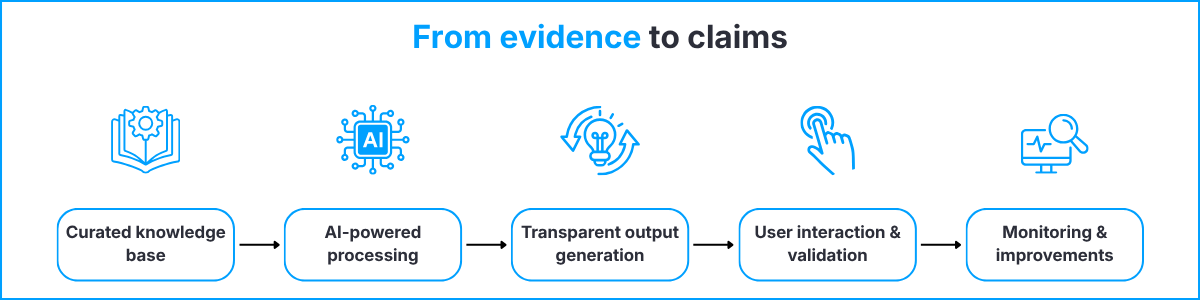
The solution follows a controlled process that starts with verified source material and ends with traceable, user-validated value messaging.
- Curated knowledge base
A controlled repository of verified scientific documents is prepared and maintained by subject-matter experts, ensuring high-quality and compliant input data. - AI-powered processing
Using LLM-based workflows, the system extracts and synthesizes relevant information, transforming it into structured, audience-specific value messaging tailored to the selected scenario. - Transparent output generation
Each generated response includes references, citations and direct links to source documents, ensuring full traceability and regulatory alignment. - User interaction & validation
Users interact with the platform through an intuitive interface, validate outputs and refine prompts, maintaining full control over the final messaging. - Monitoring & continuous improvement
Power BI dashboards track adoption, usage patterns and engagement, supporting continuous optimization and user guidance.
The platform was adopted at scale across the organization, with 150+ users onboarded, 30+ countries covered and 7+ global training sessions delivered, confirming its ability to support distributed teams across markets while maintaining a consistent way of working with approved evidence, value messaging and source traceability.
Tech stack
- LangChain – to structure LLM workflows, integrate Azure OpenAI models with Python, and enable modular task execution.
- LangGraph – to build graph-based agentic workflows for advanced orchestration of LLM-driven tasks.
- FastAPI – to build efficient and scalable APIs for backend communication.
- Azure OpenAI – to provide scalable, secure access to deployed large language models used across the solution.
- Azure Document Intelligence – document parsing
- MySQL – to store and manage references, metadata, and intermediate results.
- js – frontend application development
- Docker – to containerize the application for consistent deployment and development environments.
- AWS Elastic Container Service (ECS) – to deploy and run Docker containers in a scalable and reliable cloud environment.
- AWS CodeBuild – to enable continuous integration and automate build processes during development.
- Power BI – monitoring adoption and usage analytics
Benefits:
Market Access teams
Teams can generate high-quality, evidence-based value messages in seconds instead of hours or days, accelerating preparation for reimbursement and market access discussions. Tailored messaging supported by references, citations and source excerpts increases confidence and effectiveness in payer and HTA negotiations.
Marketing & affiliate teams
Users gain faster access to approved product-related information and can adapt messaging to different audiences, markets and languages. Standardized communication helps maintain consistency across regions while still allowing local teams to adjust content to their specific needs.
Management
Evidence extraction accuracy exceeded 90%, while time to first synthesis draft was reduced by more than 90% compared to manual workflows. Reduced reliance on manual work and external agencies allows teams to focus on strategic priorities, with Power BI dashboards supporting adoption monitoring and continuous improvement.