 (+48) 508 425 378
 office@bitpeak.pl
 Opatowska 2, Warsaw

The client
Base. (formerly BaseLinker) is a leading provider of integrated e-commerce technology solutions, empowering online retailers to streamline and scale their operations. The platform delivers a robust suite of tools that centralize the management of online stores, marketplaces, orders, and shipping processes, all from a single interface.
Specializing in automation and data-driven analytics, .base helps businesses optimize their sales workflows, enhance operational efficiency, and make informed decisions based on reliable, real-time data. Its flexible, scalable infrastructure supports seamless integration with a wide array of global marketplaces, couriers, and ERP systems, enabling merchants to unify their multichannel commerce strategy.
By simplifying complex e-commerce logistics and providing advanced analytical capabilities, Base. positions itself as a critical technology partner for businesses aiming to grow in a competitive digital marketplace.
The challenge
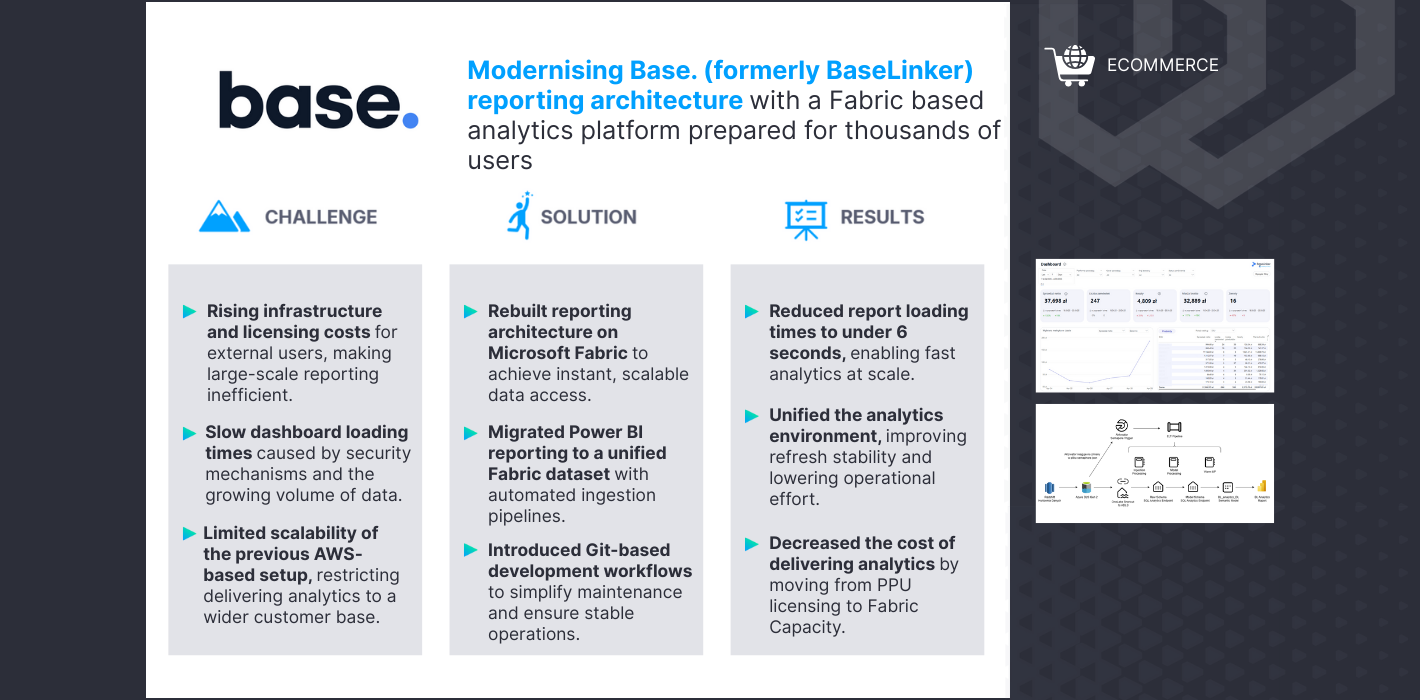
In the e-commerce industry, delivering fast, reliable, and scalable analytics is essential for day-to-day decision making. As platforms grow and the volume of transactional data increases, reporting systems must offer strong performance, secure access control and the ability to serve large user bases without disproportionate infrastructure costs. Ensuring both speed and governance becomes a critical requirement for any analytics feature embedded in a commercial product.
Meeting these expectations is not easy, which Base. experienced firsthand. Their initial reporting setup, built on AWS stack and Power BI and shared with hundreds external Clients, confirmed strong customer interest but also introduced a number of technical and business challenges, such as:
- Licensing cost for external users
- Slow dashboard loading times
- High security expectations and mechanisms that impacted the performance
- Limited scalability
The solution
BitPeak rebuilt Base. analytics capability by designing a new reporting platform on Microsoft Fabric. The goal was to eliminate performance limitations and prepare an architecture that could deliver fast, reliable insights to thousands of users. The new environment ingests data into OneLake for instant, scalable reporting.
The Microsoft Fabric provided the unified environment to tackle the initial limitations as well as deliver solid foundation for future. This created an end-to-end analytics environment that is faster, easier to maintain and fully integrated with base’s operational model.
The final solution provides a unified analytics experience with features such as:
- Fully automated analytics that reduce manual work and support faster decision making
- Daily sales reports delivering up to date insights every day
- Integration with the base. panel for full operational visibility in one place
- Comprehensive sales performance analysis covering net sales, margins, orders and returns
- Trend tracking to help identify long term sales and margin patterns
- Order and return statistics that support product portfolio optimization
To reach our goal, we used the following tech stack:
Microsoft Fabric
- Fabric capacities and workspaces
- OneLake
- Direct Lake
- Delta Lake model
- Fabric Git integration
- Fabric pipeline monitoring via webhooks
Data & Cloud
- Amazon Redshift as the source warehouse
- Azure environment for Fabric setup
Power BI
- Power BI reports migrated to Fabric dataset
- Row Level Security implemented natively in Fabric
- Power BI as the main presentation layer
Benefits:
Users
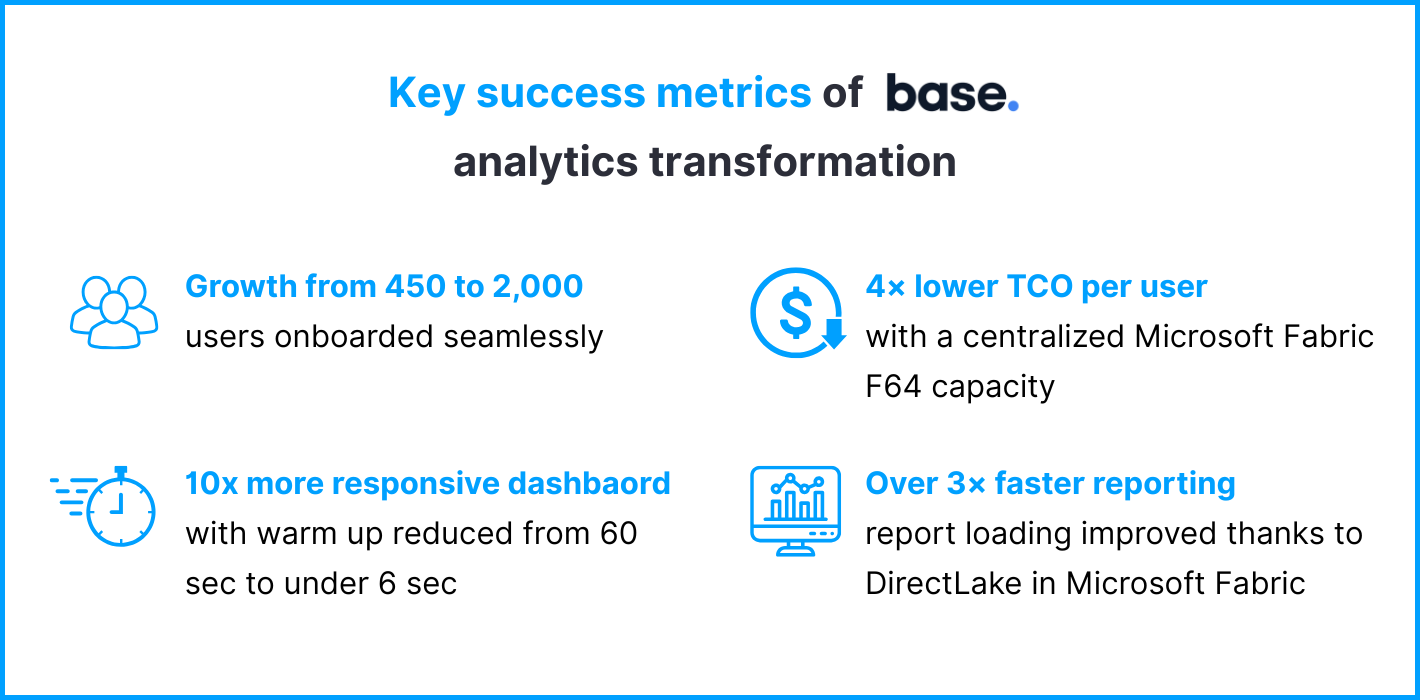
Users experience significantly faster analytics access, with report loading under 6 seconds. The new architecture supports thousands of users, making insights available at scale without performance degradation.
Operations
Git based development workflows and webhook monitoring simplify maintenance and provide clear visibility into pipeline behaviour. The unified Fabric environment ensures stable refresh cycles and predictable day-to-day operations.
Business
Switching from Premium Per User licenses to Fabric capacity reduces the cost of delivering analytics at scale. Centralising ingestion, storage, and reporting in Fabric lowers long-term operational effort and improves overall efficiency.