 +48 453 250 842
 office@bitpeak.com
 Opatowska 2, Warsaw

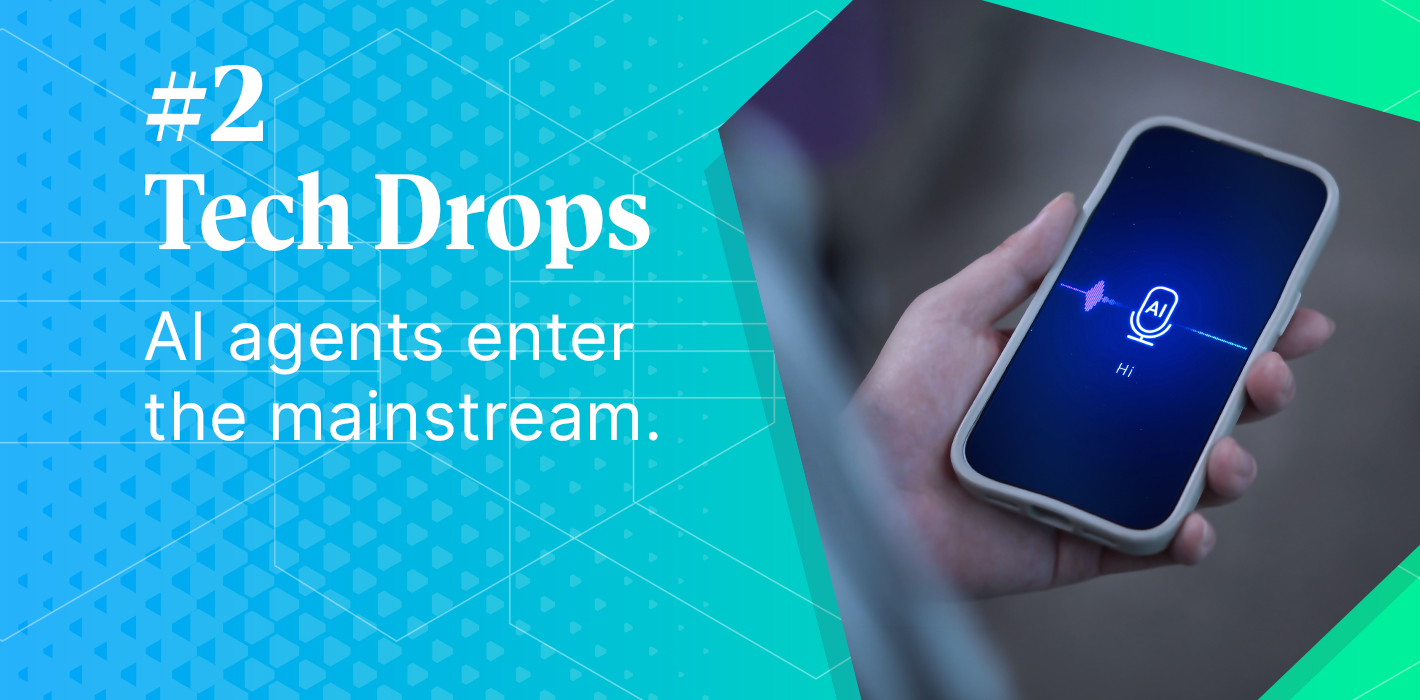
In 2025 AI agents moved from experimental concepts into real-world systems used by teams and products. Single-model assistants increasingly gave way to coordinated groups of agents capable of remembering context, using tools, and acting over time. The growing adoption of agent-based architectures now raises questions about how teams should build AI systems and what challenges may emerge in 2026.
Agent-based systems on the rise
By late 2025 the use of agent-based systems reached a new level of scale and visibility. McKinsey’s State of AI 2025 survey reported that 62 % of organisations were experimenting with AI agents, while 23 % had begun scaling them in at least one business function. Rather than replacing existing systems wholesale, teams increasingly treated agents as components that could be embedded into broader architectures.
In that context, an AI agent represents more than a conversational interface. Agents combine decision logic, access to external tools, and the ability to operate across multiple steps while retaining context. Workflows began to shift away from single prompt-response interactions toward systems where multiple agents plan, act, and coordinate within defined boundaries.
More time for innovation
Agent-based architectures change how teams approach system design and responsibility boundaries. Instead of embedding logic directly into prompts or application code, teams separate planning, execution, memory, and tool access into distinct components. Such decomposition makes complex workflows easier to extend, test, and reason about over time. Engineering effort shifts from prompt tuning toward system orchestration.
Day-to-day work also changes on an operational level. Teams gain the ability to automate longer, multi-step processes that require context retention and interaction with external systems. At the same time, new challenges emerge around observability, cost control, and failure handling when multiple agents operate in parallel. Effective use increasingly depends on clear constraints, monitoring, and fallback mechanisms rather than raw model capability.
How we apply agent-based systems at BitPeak
The shift toward agent-based architectures is not only visible in industry trends but also in how real systems are built and delivered. In our work at BitPeak, agent-based patterns have become a practical way to structure complex workflows that require coordination, context, and iterative decision-making.
One example comes from a project focused on systematic literature reviews, where agent-based workflows supported large-scale analysis of academic research. Instead of a single query-driven process, multiple agents handled search, filtering, relevance assessment and synthesis across thousands of sources, allowing the system to operate iteratively and retain context between steps.
A similar pattern was applied in a project delivered for a flight operator, where specialised agents handled different stages of operational and document analysis. Individual agents were responsible for processing contractual documents, analysing unstructured inputs, generating code for data processing tasks, verifying its correctness, reviewing test results and preparing structured summaries. Coordination logic ensured that outputs from each agent formed a consistent workflow, allowing complex tasks to be executed without concentrating all reasoning in a single model.
Agent-based architectures are no longer a speculative direction but a practical design choice that teams increasingly reach for when systems grow in complexity. As adoption continues into 2026, the key challenge will not be whether to use agents, but how to design them responsibly, observe their behavior, and integrate them into real-world workflows without losing control.