
 +48 453 250 842
 office@bitpeak.com
 Opatowska 2, Warsaw


The client
Medicover is a specialized provider of diagnostic and healthcare services, mainly focused on markets in Central, Eastern Europe and India. The company operates through two divisions – Diagnostic Services and Healthcare Services.
The challenge
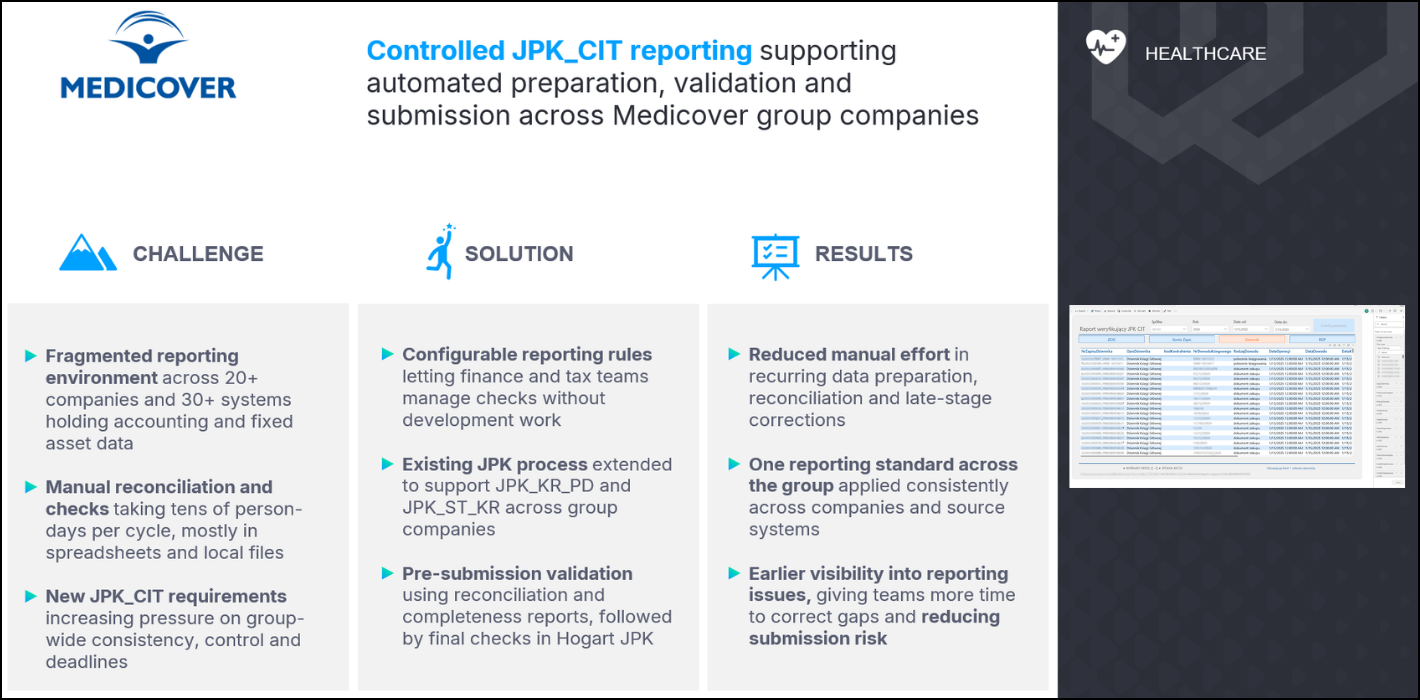
Our client runs more than 20 companies and more than 30 source systems that hold accounting and fixed asset data. Before every mandatory report, someone has to pull all of it together, reconcile it and check it – by hand, in spreadsheets. That work took tens of person-days per cycle. The checks lived in local files rather than in one place, so nobody could apply one standard across the group. Errors surfaced late, close to the deadline, when there was the least time left to fix them.
In 2025 the stakes rose. New rules required large CIT taxpayers to send annual electronic accounting reports to the Ministry of Finance in the JPK_KR_PD and JPK_ST_KR formats. The change covered group companies across the whole structure and called for consistent accounting and fixed asset data in every one of them. The client already ran a BitPeak solution to consolidate financial data for reporting, so the task was not a new system but a wider one: prepare, check and submit JPK_CIT data under control, and hold that control in every cycle after the first.
Our solution
BitPeak built a tool that consolidates financial data from many source systems and puts the business rules behind it in the hands of the people who own the numbers. The rules – what to check, what to complete, how to shape the data for a given report – sit in one configurable layer instead of in code or in local spreadsheets. Finance and tax teams edit them themselves, with no development work and no ticket to IT, and every change applies across all group companies at once. New requirement, new check, changed reporting scope: the same layer absorbs it.
This is what makes a new obligation an extension rather than a new project. The tool already produced the group’s JPK_VAT reporting on this model. When the Ministry of Finance introduced JPK_KR, we widened the same mechanism to cover it – no parallel process, no second set of rules to keep in step.
For JPK_CIT we added the preparation, validation and transfer steps that JPK_KR_PD and JPK_ST_KR require, across every company in the group. The tool loads accounting and fixed asset data from the source systems, applies the group’s checks at warehouse level and publishes reconciliation and completeness reports. Teams see gaps and mismatches early, while there is still time to fix them at the source. Data that passes goes on to Hogart JPK, the application that builds the final JPK files, where a further set of checks runs before submission. Errors stop surfacing at the last step.
The extended reporting process connects Medicover’s financial and accounting source data with the steps required to prepare, validate and generate JPK_CIT files. Accounting and fixed asset data from group companies are standardized for JPK_KR_PD and JPK_ST_KR, then undergo validation and control before file generation in Hogart JPK.
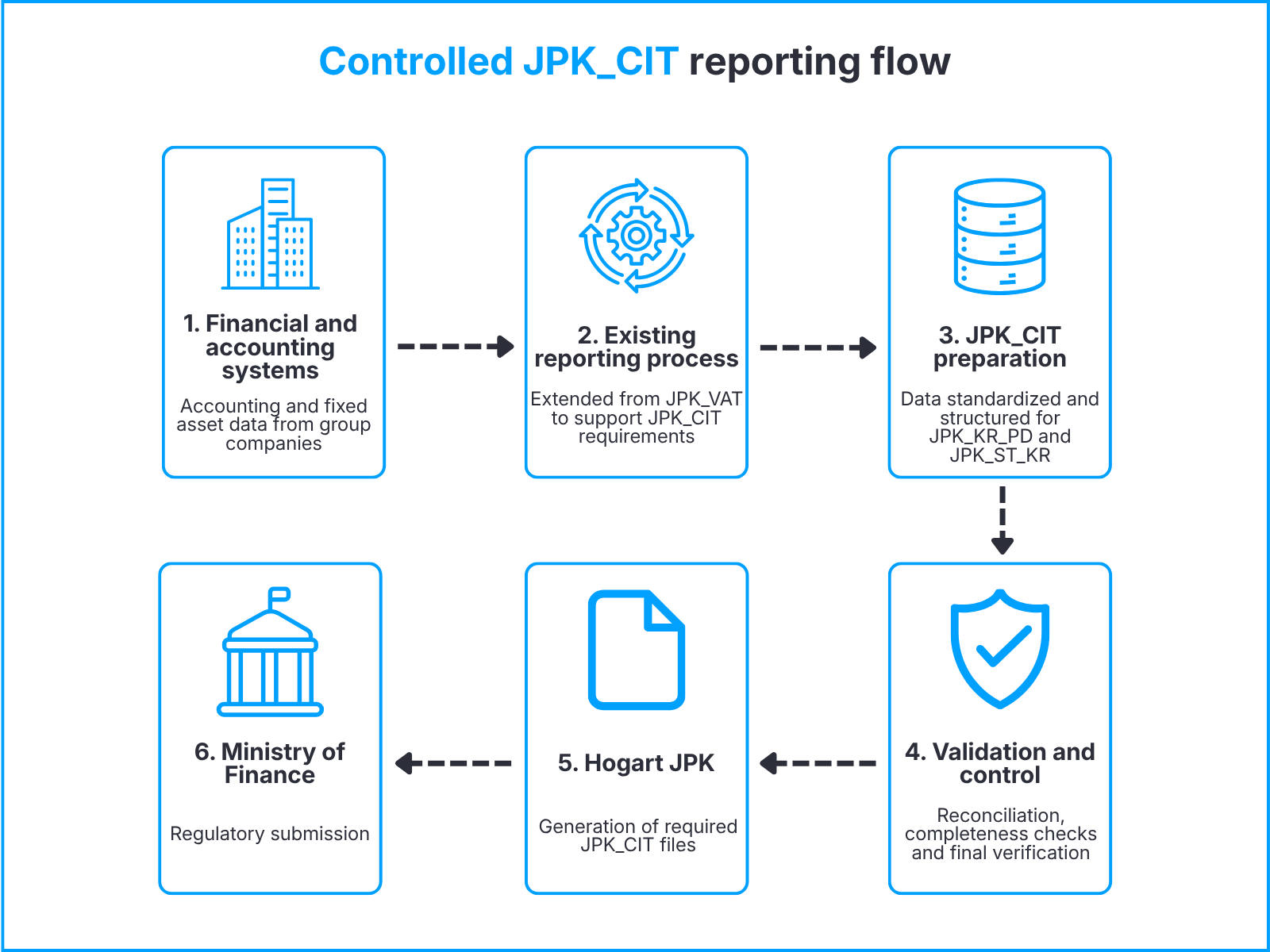
The flow shows where the process reduces manual work and strengthens control before submission to the Ministry of Finance: from source data, through JPK_CIT preparation and completeness checks, to the final regulatory files.
Tech Stack
The solution was built using Microsoft Azure technologies supporting data processing, orchestration, reporting, monitoring and deployment.
- Synapse SQL
- Apache Spark for Synapse
- Synapse Pipelines
- Power BI
- Azure DevOps
- Azure Active Directory
- Azure Monitor
Benefits
Accounting and tax teams
The solution reduced repetitive manual work in each reporting cycle by automating JPK_CIT data preparation and introducing validation reports before final submission. Accounting and tax teams can detect irregularities earlier, correct them faster and spend less time on manual checks at the end of the process.
Group data governance
A unified reporting process helps enforce consistent data quality and reporting standards across all group companies. Instead of each entity handling JPK_CIT independently, Medicover gained one standardized approach to preparing data for JPK_KR_PD and JPK_ST_KR files.
Compliance
Pre-submission validation reduces the risk of sending incomplete or incorrectly prepared files to the Ministry of Finance. The process also lowers the risk of missing mandatory deadlines, supporting safer and more predictable regulatory reporting across the group.
Data operations
By extending the existing warehouse architecture used for JPK_VAT, the solution reduced implementation complexity and created a scalable foundation for future reporting needs. The same architecture can support further development as regulatory or business requirements evolve.