 +48 453 250 842
 office@bitpeak.com
 Opatowska 2, Warsaw



Cloud migration is meant to simplify how companies manage data and infrastructure. In reality, the decision is rarely simple, and it has long-term consequences for the whole organization. While preparing a Landing Zone for a client, I kept noticing how a choice like picking a cloud provider goes far beyond purely technical considerations.
A Landing Zone is the foundational cloud environment where governance, security boundaries, and operational standards get defined before any workload lands. This is exactly why comparing the Azure and AWS Cloud Adoption Frameworks (CAFs) is worth doing. After all, a choice of framework reveals more about your company’s DNA than its technical requirements.
More than a choice of cloud provider
Cloud computing has two giants, and from far enough away, they look like they’re selling the same thing. Both Microsoft Azure and Amazon Web Services (AWS) ship a Cloud Adoption Framework (CAF), complete with documentation, best practices, and tools for managing risk, governance, and scale.
Look closer, though, and they pull in different directions. Each one carries the DNA of the company that built it. And with 86% of enterprises already running multi-cloud environments, knowing where those differences actually bite matters more than it used to.
This article breaks down both frameworks. My take, in short: Azure is built for the centralized, regulated enterprise, and AWS is built for the team that wants to move fast and stay decentralized. Miss that distinction and the rest of the transformation gets harder than it needs to be.
Part I: How do the two frameworks structure cloud adoption?
Let’s start with a high-level view of both frameworks and how they structure the cloud adoption journey.
Microsoft Cloud Adoption Framework (Azure CAF)
Azure CAF organizes guidance into seven methodologies. Strategy, Plan, Ready, and Adopt run sequentially; Govern, Secure, and Manage run in parallel throughout the journey:
| Methodology | Outcome |
| Strategy | Cloud adoption aligned to business goals |
| Plan | A plan for cloud adoption with operating model and cost estimation |
| Ready | An Azure environment ready for workloads with landing zones |
| Adopt | Workloads in Azure meeting business needs through migration or modernization |
| Govern | Control workloads and assess cloud risks |
| Secure | Protect workloads with Azure and Microsoft tools |
| Manage | Optimize workloads continuously |
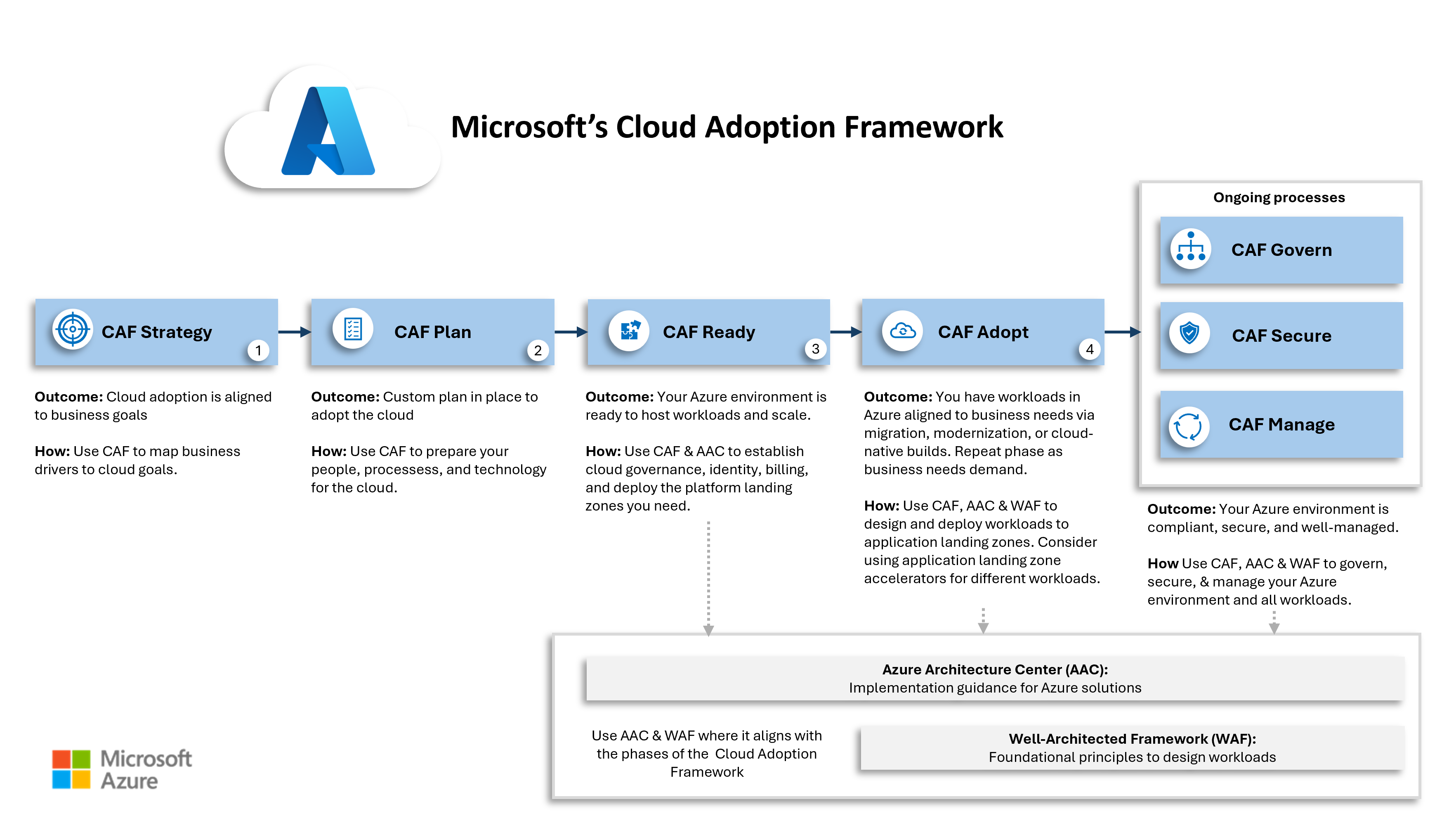
Microsoft’s Cloud Adoption Framework | Source: learn.microsoft.com
AWS Cloud Adoption Framework (AWS CAF)
The AWS Cloud Adoption Framework leverages AWS’s experience and best practices to accelerate cloud-powered digital business transformation. It identifies organizational capabilities grouped into six perspectives across four iterative phases:
The six perspectives:
| Perspective | Outcome |
| Business | Ensures IT aligns with business needs |
| People | Develops teams and skills |
| Governance | Manages risk and compliance |
| Platform | Builds and runs enterprise-grade platforms |
| Security | Ensures data and workload security |
| Operations | Delivers services to the business |
The four iterative phases:
- Envision: Identify and prioritize transformation opportunities aligned with strategic objectives
- Align: Identify capability gaps and cross-organizational dependencies
- Launch: Deliver pilots in production to demonstrate incremental business value
- Scale: Expand successful pilots to desired scale
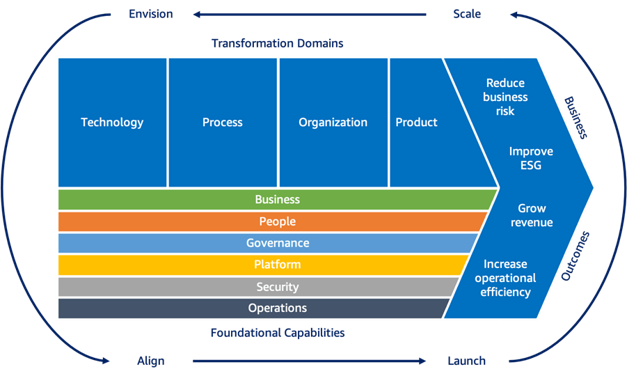
AWS Cloud Adoption Plan | Source: aws.amazon.com
The surface similarity
Both frameworks integrate with their respective Well Architected Frameworks and address people, process, and technology holistically. Both are trusted by governments, healthcare providers, and regulated industries. But this is where the resemblance ends.
Part II: Where do Azure and AWS begin to diverge?
The real distinction between the frameworks becomes visible when we examine how they handle governance, architecture, and organizational structure. I will describe the key differences between the two approaches and explain what drives them.
Difference #1:
Governance – The Scalpel vs. The Gate
In Azure, governance is handled primarily through Azure Policy, which checks resource properties from within a subscription: whether a disk is encrypted, a SQL version is compliant, or a resource carries the required tags.
AWS takes a different approach. Service Control Policies (SCPs) define account-level boundaries above the organization and block prohibited actions before an account can perform them.
The Root Cause: Resource Hierarchy vs. Account Isolation
Microsoft designed Azure around a flatter subscription hierarchy, where subscriptions act as “units of scale” rather than hard security boundaries. As a result, governance needs to operate close to the resource level.
The AWS model grew out of a strict multi-account strategy, with each account serving as a security perimeter. This places governance at the account’s edge, stopping problematic actions before they enter the environment.
Difference #2:
Landing Zones – Empowerment vs. Isolation
The Azure approach favors Subscription Democratization: give business units their own subscription and let them run, using policy as the guardrail.
AWS goes the other way, isolating every workload into its own account under a Well-Architected Multi-Account Strategy – if one team makes a mistake, the damage stops at that account’s edge.
The Root Cause: Technical Limits and Default Quotas
Because Azure has historically supported large workloads within a single subscription, extending subscriptions to application teams became a natural operating model.
On the other hand, AWS has always enforced tighter per-account service limits to avoid noisy-neighbor problems – so scaling means creating new accounts, and landing zones become an exercise in managing a fleet of them..
Difference #3:
Transformation Phases – Sequential Build vs. Iterative Launch
Azure has a distinct “Ready” phase that has to finish before “Adopt” starts, nothing moves until the platform team says the foundation is ready.
By comparison, AWS runs an Envision -> Align -> Launch -> Scale loop instead, starting small and iterating back to Align or Envision as it scales.
The Root Cause: Central IT Control vs. Startup Agility
Behind the Azure model is the assumption that a central Cloud Center of Excellence (CCoE) builds the foundation before adoption spreads. The runway goes in before any plane takes off.
A decentralized, agile operating model shapes the AWS approach instead: build a minimal runway, launch a small pilot, learn from it, then build a bigger airport based on what you learned.
Part III: What does each approach enable in practice?
These architectural differences translate into specific advantages for different types of organizations. Once we understand the philosophy behind each framework, those benefits become much easier to assess.
Benefits of the Azure CAF Approach
- Smoother transition for traditional enterprises
Because Azure mirrors the IT Project Lifecycle (Plan -> Ready -> Adopt), it feels natural to existing ITIL-aligned teams. It reduces the learning curve for project managers and governance committees. - Granular, built-in compliance
Azure Policy allows for “in the weeds” compliance. You can enforce that every single resource has a specific tag, uses a specific disk SKU, or enables encryption at rest. This is crucial for industries with heavy data compliance requirements like finance and healthcare. - Hybrid consistency (the Arc Advantage)
Azure’s framework extends naturally to on-premises and edge locations via Azure Arc. For companies that will remain hybrid such as retail operations with physical stores or manufacturing with factory floors Azure provides a single control plane for both cloud and on-premises environments.
Benefits of the AWS CAF Approach
- Superior isolation and blast radius control
The hard multi-account strategy means that if one application or development team makes a mistake, the blast radius is limited to that single account. A compromised credential in a development account cannot bring down the production environment. - Operational clarity through specialization
Because each account has a specific purpose (Dev, Test, Prod, Security, Logging), there is no ambiguity in ownership. Cost allocation to specific business units becomes straightforward, and applying specific security baselines to specific workloads is simplified. - Proven performance gains
Cloud Value Benchmarking shows a 27% reduction in cost per user, a 58% increase in VMs managed per administrator, 57% less downtime, and 34% fewer security events when migrating from on-premises to AWS.
Part IV: Which framework fits which type of organization?
From my experience in Data Platform Administration, the choice between these frameworks is shaped mainly by an organization’s culture and operating model. The better fit is the one that supports how the organization already makes decisions, manages responsibility and works across teams.
The Azure CAF company: “The Enterprise Regulator”
Ideal profile:
- Size: Large Enterprise (10,000+ employees) or Public Sector
- Industry: Finance, Government, Healthcare, Manufacturing
- IT Culture: Centralized IT control, Heavy Microsoft ecosystem (Windows, Active Directory, SQL Server), Existing ITIL/COBIT processes, Hybrid, first mindset
Real-world example:
Erste Bank Polska (formerly Santander Bank Polska) worked with BitPeak to modernize how data moves through its Azure-based Cloud Data Lake — a configuration-driven framework across the Bronze and Silver layers that embeds governance, anonymization, and retention rules directly into the pipeline. New data sources now onboard in days instead of weeks, with stronger audit readiness.
Why it fits:
Azure CAF provides a top-down control mechanism. It allows a central team to build a compliant foundation and then delegate safely. It turns cloud adoption into a manageable, predictable project where governance is built in from the start.
The AWS CAF company: “The Digital Native”
Ideal profile:
- Size: SMB to Mid, Market, or Innovation units within large enterprises
- Industry: Technology, SaaS, E-commerce, Media, Startups
- IT Culture: Decentralized DevOps teams, Agile development, Strong engineering focus, Containerization, API, first mentality
Real world example:
Post Bank Poland, an example from AWS’s own published case study, offers a useful AWS-side parallel: migrating its electronic banking system cut deployment time from two hours to ten minutes and reduced CPU utilization by 40%, while staying fully compliant with Poland’s financial regulations.
Why it fits:
AWS CAF provides a bottom-up empowerment engine. teams get their own isolated accounts and the freedom to move fast, while SCPs sit in the background to catch the worst mistakes before they cause real damage. Speed and safety aren’t a trade-off here – they’re just two settings on the same system.
The middle-ground: What about multi-cloud?
Most large companies are becoming multi-cloud by design, using AWS CAF at the customer-facing edge and Azure CAF at the regulated core. As Jo Peterson of Clarify360 puts it, hyperscalers are shifting from “winner takes all” toward a more collaborative posture as customer demand pushes them together.
Part V: The future – AI, hybrid cloud, and evolving frameworks
As we look toward 2026 and beyond, both frameworks are evolving to address new priorities:
AI Integration:
Both frameworks are racing to fold in agentic AI. AWS’s Matt Garman talks about “AI assistants giving way to AI agents that can perform tasks and automate on your behalf,” and Azure is weaving Copilot across its enterprise stack, with CEO Satya Nadella noting that Microsoft is “helping customers unlock the full ROI of AI.”
Hybrid cloud expansion:
Gartner predicts 90% of organizations will run hybrid cloud by 2027, and both Azure Arc and AWS Outposts are expanding to meet thatBoth Azure Arc and AWS Outposts/Local Zones are expanding to provide consistent hybrid experiences.
The “Co-opetition” reality:
AWS and Google Cloud have announced a cross-cloud interconnect deal, with Azure expected to join in 2026– For me it’s proof that even fierce competitors bend when customers demand flexibility.
Which approach fits your organization’s DNA?
Azure and AWS didn’t just build different frameworks. They built them around different assumptions about how organizations work. Azure bets on control and centralized governance. AWS bets on speed and isolated teams.
Choose Azure CAF if you’re a regulated enterprise with deep Microsoft investment and a need for granular, built-in compliance.
Choose AWS CAF if you’re a technology-driven organization with autonomous teams and a culture of infrastructure as code.
Whatever you choose, it should give you a clear direction now and enough room to change your mind later, because your organization will.
***
All content in this blog is created exclusively by technical experts specializing in Data Consulting, Data Visualization, Data Engineering, and Data Science. Our aim is purely educational, providing valuable insights without marketing intent.