 +48 453 250 842
 office@bitpeak.com
 Opatowska 2, Warsaw



A data archive can work quietly in the background for years – until it doesn’t. And when its limitations finally become visible, they can affect processes that have long since become critical to the organization.
As a Business Analyst, I have worked with organizations at very different levels of data management maturity, and their approach to data archiving has often been surprisingly revealing. At some point, every growing organization needs a place for systems and data that must remain available long after their everyday use has ended, and a ready-made archiving solution is often the natural choice. It provides clear boundaries, proven functionality and a sense that the problem has been solved. At least for a while.
When does a reliable archive start falling behind?
For years, this setup may work exactly as expected. The company grows, new systems appear, mergers or acquisitions bring additional data, and the archive grows with them. It may have its limitations, but it remains stable, secure and sufficient for its users. As long as those basic expectations are met, there is little reason to rethink a system that has quietly become part of the organization’s infrastructure.
The challenge begins when the expectations placed on that system change. GDPR is a good example: retention periods, data deletion and privacy by design introduced requirements that many older archive solutions were never built to handle. Organizations adapted by redesigning processes and adding supporting mechanisms around existing systems, often successfully at first. Over time, however, these additions can become part of the archive itself, bringing more manual work, performance constraints and dependencies while the business continues to expect better access and new functionality. I encountered this exact pattern in one of the archiving projects I worked on, and it made me look more closely at the signs that an archive is no longer keeping pace with the organization around it.
When an archive becomes critical infrastructure
Many archival platforms did not start as strategic products. They were introduced to move inactive records out of operational systems and keep them available when needed. Over time, however, more source systems were connected, data volumes increased and new stakeholders began to rely on the same platform:
- the business expects one search across years of records,
- auditors need the full context of a case,
- compliance teams require evidence that data has remained complete and unchanged,
- IT wants a dependable source of truth.
A system designed as a supporting repository gradually becomes a critical part of the IT ecosystem, even though no one explicitly intended to build it that way.
This is where technical debt becomes difficult to ignore. Each new requirement is reasonable in isolation, but together they turn the archive into an all-purpose machine that nobody formally commissioned. Adding another workaround may keep the system running, but it also increases manual work, dependencies and the cost of future change.
Managing the debt starts with recognizing that the archive is no longer “just storage.” It is a product used by several groups, and its current role should be assessed against the architecture, ownership and capabilities it has, rather than the modest purpose for which it was originally purchased.
Stored does not mean findable
Recognizing the archive as a product is only the first step. Its value is tested when someone needs to reconstruct a specific case. In one project, I encountered an archive with thorough documentation and clearly described data structures, yet finding all records for a single customer still required a sequence of manual steps: querying several databases, applying different filters and reconciling the results. The information was there, but access to it depended on specialist knowledge and time.
An effective archive needs consistent indexes, meaningful metadata and search mechanisms that connect records to the right person while respecting permissions and preserving integrity. Without that layer, every request becomes a small investigation rather than a repeatable process.
Compliance cannot depend on the next release
Searchability is one part of the challenge. An archive also has to keep pace with regulatory requirements that continue to evolve throughout its lifetime. Across Poland and the EU, evolving rules for electronic documentation, digital reproductions, long-term preservation and reuse continue to raise the standard that archival systems must meet. A platform may therefore remain technically stable while gradually falling behind its legal environment.
For archive owners, a regulatory change rarely translates into one isolated feature. It creates a chain of practical questions:
- Can we trace a record back to its source and acquisition date?
- Can we demonstrate that it has not been altered without authorization?
- Can retention, deletion and access rules be applied consistently across every connected dataset?
- Can the same material be safely reused or shared without losing its context?
With a ready-made platform, the answers often depend on the vendor’s roadmap: support for a new requirement may be promised in the next release, while the organization still has to remain compliant today. In the project I worked on, this gap was initially covered by a separate supporting solution built alongside the archive. Over time, it became a critical part of the process, required increasing amounts of manual work from business analysts and eventually created a performance bottleneck: one batch of deletion requests could not be completed before the next arrived. The only remaining operational buffer was to schedule deletion as late as permitted by applicable regulations. It’s a clear sign that a temporary workaround had become a constraint on the entire system.
An opaque archive limits AI
Alongside regulatory pressure, business expectations around archival systems are evolving as well. Stakeholders increasingly ask for AI-assisted classification, semantic search and instant descriptions of datasets. These capabilities, however, depend heavily on the quality and structure of the underlying data. If records are fragmented, duplicated or described inconsistently, AI can amplify existing ambiguity and make it more visible at scale.
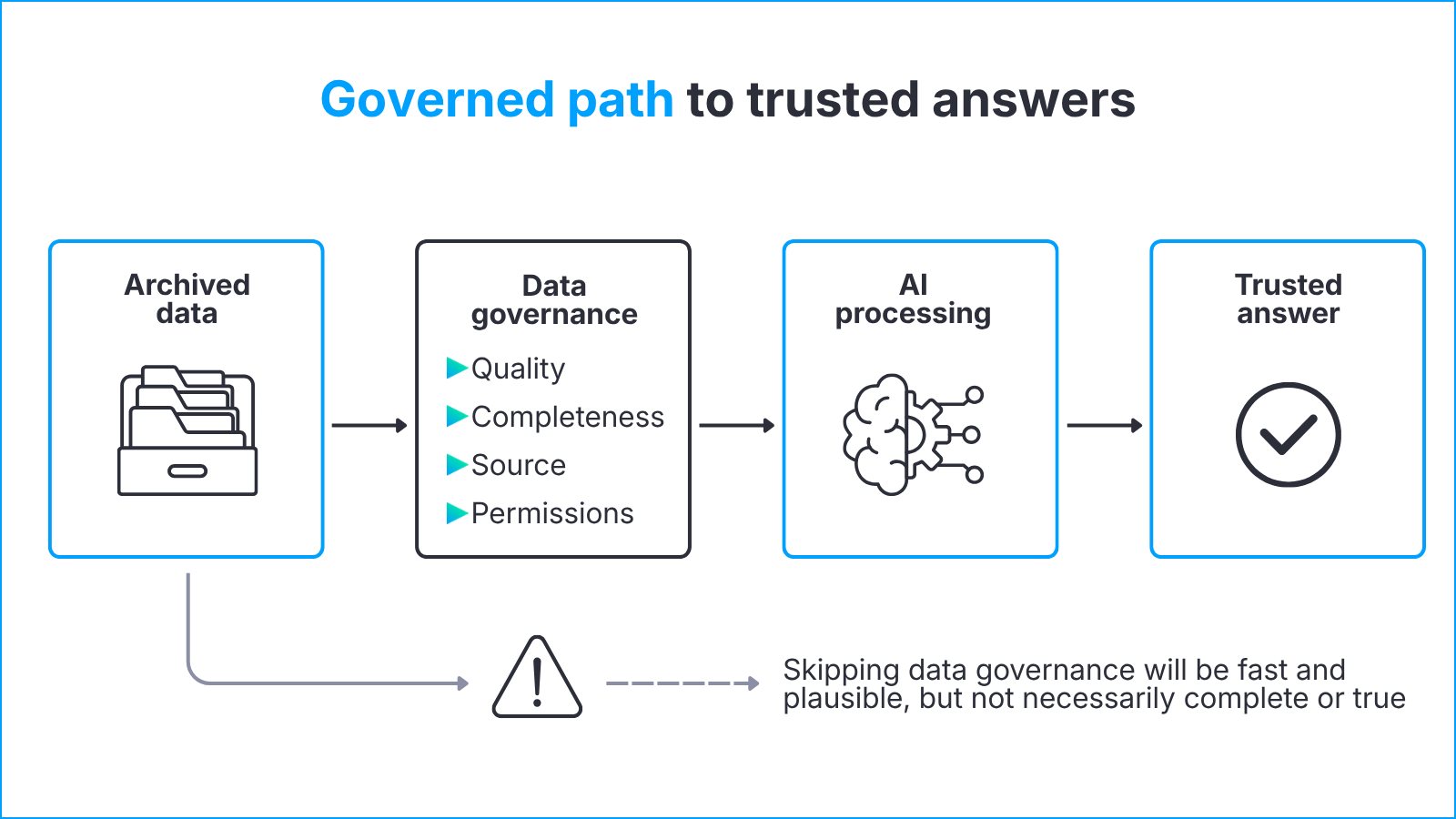
Before introducing these capabilities, the organization needs to establish which datasets are complete, which sources are authoritative, who owns their quality and how access to them should be controlled. This is where data governance becomes a practical requirement rather than an abstract policy. Without it, the archive may become easier to query, but users will still be unable to determine whether an answer is complete, current and trustworthy. Many legacy archival solutions were designed before data governance became an explicit organizational discipline, so they were not built to support these controls consistently.
The cost of an archive is often hidden
An archive rarely generates direct revenue, which makes investment in modernization, monitoring, performance testing, or data migration difficult to justify relative to more visible business initiatives. Its real cost is dispersed across storage, licences, infrastructure, specialist support, manual work and delays in responding to business or regulatory requests. Because these expenses appear in different budgets and processes, maintaining the current platform can look cheaper than it actually is.
A few operational metrics can turn these hidden costs into evidence for decision-makers:
- What is the total annual cost of retaining 1 TB of data, including infrastructure, licences and operational support?
- How much time and how many people are needed to reconstruct a complete case?
- What percentage of searches return the correct records on the first attempt?
- How many hours of manual work are required each month to process deletion requests, prepare audit evidence or reconcile data?
These indicators do not produce a complete business case on their own, but they reveal whether the archive is becoming more expensive and less effective over time. They also give Product Owners evidence they can take to decision-makers when comparing continued maintenance or migration to a solution designed around the organization’s actual needs.
Do not wait for the archive to fail
Not every archive should be rebuilt and not every archive is worth indefinitely expanding. If several of these warning signs resonate with you: difficult downloads, compliance dependent on secondary processes, data unprepared for new uses, and costs that no one can clearly explain, the next step is to discuss whether the current platform is still fit for purpose for the organization.
That assessment should distinguish between problems that can be solved within the existing system and limitations that have become structural. Better indexing, clearer ownership, stronger data governance or additional automation may be enough in some cases. In others, continuing to add functionality to the same platform only increases complexity. The realistic options may then include maintaining the archive within a clearly defined scope, freezing further development and moving new capabilities elsewhere, or migrating the data to a platform designed around current requirements.
The decision should be based on evidence: the total cost of ownership, the effort hidden in manual processes, compliance risk, migration effort and the capabilities the organization is likely to need next. A system does not have to fail before it becomes a poor strategic fit. Identifying that point early gives the organization more room to choose its next step instead of being forced into one by an operational or regulatory problem.
***
All content in this blog is created exclusively by technical experts specializing in Data Consulting, Data Visualization, Data Engineering, and Data Science. Our aim is purely educational, providing valuable insights without marketing intent.