 +48 453 250 842
 office@bitpeak.com
 Opatowska 2, Warsaw


The client
A globally diversified healthcare company with a central purpose to help people live their healthiest possible lives. The organization offers a broad portfolio of market-leading products that align with favorable long-term healthcare trends in both developed and developing markets. With more than 115 000 employees and 4000+ FLMs in 160+ countries discovering new ways to make life better.
The challenge
In regulated healthcare markets, developing marketing campaign concepts requires more than creativity. Teams need to combine product information, brand guidelines, local market context, competitor activity, and regulatory constraints into concepts that are both memorable and usable in practice.
For our client, the early stage of campaign development was especially demanding because teams operate in a restricted pharmaceutical marketing environment. Creating the first campaign direction, including the main insight, narrative, tagline, character idea and key visual concept, required fresh thinking, market awareness and control over brand consistency. The client needed a way to accelerate early ideation while helping teams explore more diverse creative directions without losing control over compliance, local context and quality.
The key business needs included:
- Expanding the creative idea space by exploring less obvious campaign concepts, taglines, narratives and visual directions.
- Accelerating initial campaign preparation for target markets without removing human control from the creative process.
- Using local market and competitor context to support culturally and linguistically relevant campaign ideas.
- Maintaining alignment with brand guidelines and market restrictions while testing multiple creative variants.
- Reducing costly manual iterations in early visual development by generating and comparing alternative key visual directions faster.
This version stays close to the internal material: the project aimed to shorten and streamline the initial marketing campaign development process, from context gathering to campaign concept and key visual generation, using a conversational GenAI process with feedback loops.
The solution
We designed the solution as a conversational GenAI application that guides marketing teams through the early stages of campaign concept development. Instead of generating a single output, the system works as an interactive workflow, allowing users to provide context, refine assumptions, review options and select the strongest creative direction.
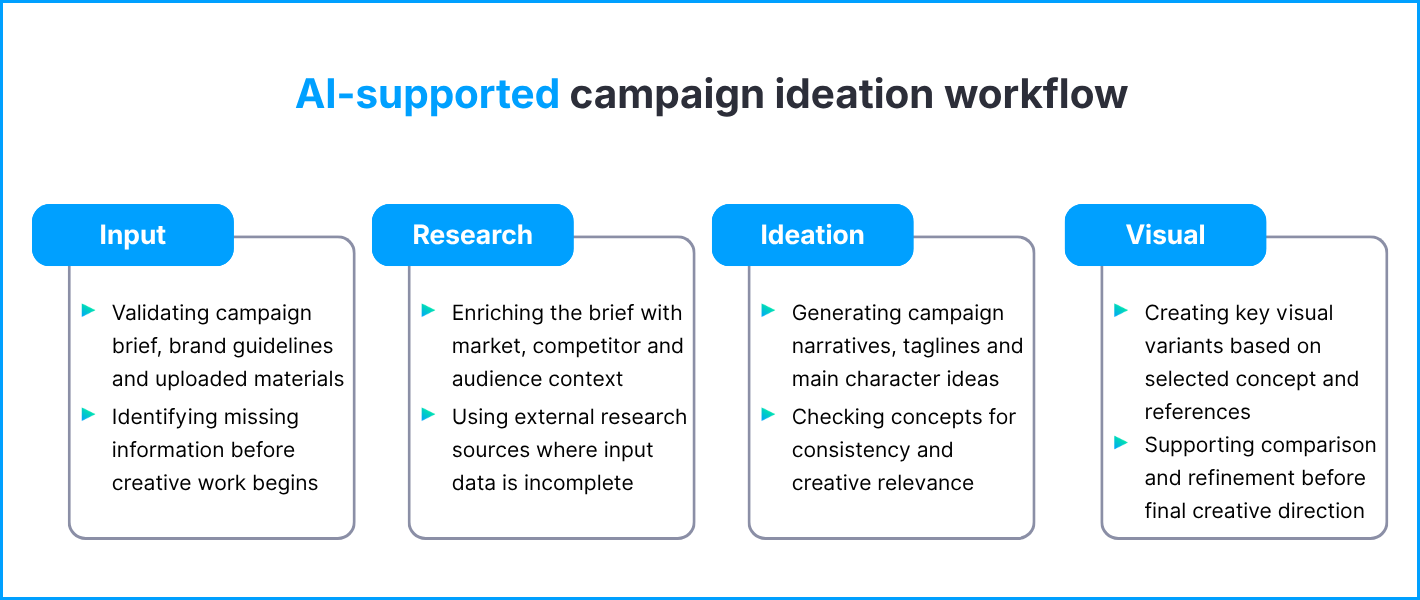
The process starts by collecting campaign inputs from the chat and uploaded materials, such as product information, brand guidelines, target market context and visual references. When key information is missing, the system can trigger research modules to gather market and competitor context from verifiable sources, enriching the brief before the creative stage begins.
Based on this structured context, the ideation workflow generates campaign concepts, including narrative direction, tagline proposals, justification, and main character ideas. Based on an AI-powered evaluation procedure we have developed, each proposal is assessed for completeness and consistency before being presented to the user, ensuring stronger control over quality, adherence to constraints, and relevance.
After the user approves or refines the concept, the system generates key visual variants using available references such as logo, packshot, tagline and selected character direction. At each stage, users can compare options, provide feedback and choose the preferred variant, reducing the risk of inaccurate outputs and making early creative exploration faster and more structured.
Tech stack
To reach our goal we used the following tech stack:
- UI Layer: Chainlit as a conversational interface to guide the user through the process and handle feedback iterations.
- Orchestration and Agentic Workflows: LangChain + LangGraph (subagent as a tool, workflow status, checkpointing, step checklists, and feedback loops).
- LLM: Azure Foundry (generating and validating the process, building prompts for image generation, mapping input data to the campaign structure).
- Image Generation: Vertex AI (image generation model) for creating key visuals based on prompts and references.
- Research: Perplexity API for obtaining market context and competitor activity along with sources.
- Storage: Azure Blob Storage for storing user attachments and generated assets (variants of characters and key visuals).
- Database: PostgreSQL for persisting campaign objects and storing conversation history.
- Telemetry: Arize Phoenix for tracking and analyzing the flow of LLM calls (debugging and quality observability).
Benefits:
Market Access teams
Teams can generate high-quality, evidence-based value messages in seconds instead of hours or days, accelerating preparation for reimbursement and market access discussions. Tailored messaging supported by references, citations and source excerpts increases confidence and effectiveness in payer and HTA negotiations.
Marketing & affiliate teams
Users gain faster access to approved product-related information and can adapt messaging to different audiences, markets and languages. Standardized communication helps maintain consistency across regions while still allowing local teams to adjust content to their specific needs.
Management
Evidence extraction accuracy exceeded 90%, while time to first synthesis draft was reduced by more than 90% compared to manual workflows. Reduced reliance on manual work and external agencies allows teams to focus on strategic priorities, with Power BI dashboards supporting adoption monitoring and continuous improvement.